Competency Health: The New Standard for Workforce Capability in 2026 and Beyond
In this article
For years, organisations have focused on performance management, training delivery and succession planning as separate activities. Yet as businesses become more data driven and risk aware, a new phrase is gaining traction in boardrooms and HR strategy meetings alike: competency health.
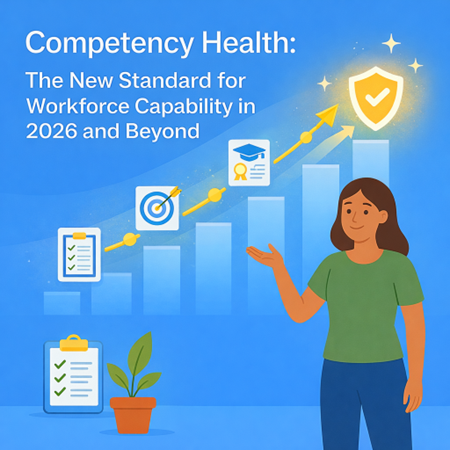
Competency health refers to the measurable state of an organisation’s workforce capability. It goes beyond training attendance or annual appraisals. It asks a more strategic question: do we have the right skills, at the right level, in the right roles, to execute our strategy safely and effectively?
As we move into 2026, competency health is becoming a critical business metric, closely linked to workforce planning software, skills gap analysis software and competency management systems.
What Is Competency Health?
Competency health is the collective strength, resilience and alignment of the skills within an organisation.
It combines several key components:
- The presence of defined competency frameworks
- The accuracy of employee competency evaluation
- Visibility of skills gaps
- Alignment between business strategy and workforce capability
- Risk exposure in critical roles
Where traditional HR systems track people, competency health systems track capability.
This shift is subtle but powerful. It reframes workforce management from administration to strategic infrastructure.
Why Competency Health Is Rising in Importance
Several forces are driving this change.
First, workforce volatility. Organisations face high turnover, changing skill requirements and increasing automation. Without visibility of workforce readiness assessment data, leaders are exposed to operational risk.
Second, regulatory pressure. In regulated sectors such as engineering, energy, healthcare and infrastructure, organisations must demonstrate that employees are competent to perform their roles. Competency tracking software and HR competency management software are no longer optional tools.
They are compliance safeguards.
Third, strategic transformation. Digital transformation, sustainability initiatives and AI adoption all require new skills. Strategic workforce planning tools must be fed by accurate skills mapping software and workforce skills analytics.
Competency health is the unifying lens that connects these pressures.
From Competency Frameworks to Competency Health
Many organisations begin with competency framework development. They build behavioural competency frameworks, technical competency frameworks and leadership competency frameworks.
However, frameworks alone do not guarantee health.
Competency health emerges when organisations:
- Map roles to clear, role based competency frameworks
- Use competency assessment software to measure proficiency
- Apply skills gap analysis tools to identify risk
- Monitor workforce capability assessment trends over time
In other words, a framework is the structure. Competency health is the live condition of that structure.
Measuring Competency Health
A modern competency management platform enables organisations to quantify health through data.
Key metrics may include:
- Percentage of workforce assessed against defined competencies
- Number of critical roles below required proficiency
- Employee skills gap analysis by department
- Leadership skills gap analysis for succession readiness
- Training needs analysis tool outputs linked to performance
Advanced enterprise competency management systems can provide workforce intelligence platform dashboards showing heatmaps, gap severity indexes and progression trends.
This moves HR from reactive to predictive.
The Role of Skills Gap Analysis
At the heart of competency health is skills gap analysis software.
Without structured gap visibility, organisations cannot:
- Prioritise training investment
- Reduce operational risk
- Strengthen succession planning
- Align talent with strategic objectives
Skills mapping software and skills tracking software allow leaders to see not only where gaps exist, but how they evolve.
In 2026, this kind of capability transparency will be expected rather than innovative.
Competency Health and Leadership
Leadership competency assessment is a particularly high value area.
Boards increasingly want to know:
- Do we have leadership depth?
- Are future leaders ready?
- Are executive roles over reliant on individuals?
Executive competency assessment tools, combined with competency based performance management, provide defensible answers.
Competency health therefore becomes a board level discussion, not just an HR initiative.
How Comaea Supports Competency Health
Comaea’s competency management software is designed to support organisations in measuring and strengthening competency health across the enterprise.
Through a structured competency management system, organisations can:
- Build and maintain competency framework software structures
- Conduct employee competency evaluation at scale
- Run skills gap analysis and workforce readiness assessment
- Align competency based training software outputs with business strategy
- Track improvement over time
The platform integrates workforce capability assessment with real time data visibility, enabling strategic workforce planning based on evidence rather than assumption.
In essence, Comaea turns competency health into a measurable, manageable business asset.
The Future of Workforce Capability
As we move further into 2026, the organisations that thrive will be those that treat competency data as strategic currency.
Competency health will sit alongside financial health, operational performance and safety metrics as a core business indicator.
The question will no longer be: have our people been trained?
It will be: are we capability fit for purpose?
With the right competency management solution in place, that question becomes answerable.